All-in-One Channel Strip Plugin
Satori Channel.
The Moment Mixing Becomes Clear.
Filters. Gate. Nine saturation modes. Compression. Transient shaping. Musical EQ. De-essing. Stereo generation. Psychoacoustic panning. Clipping. Limiting. Your entire processing chain, brought into one focused, musical workflow.
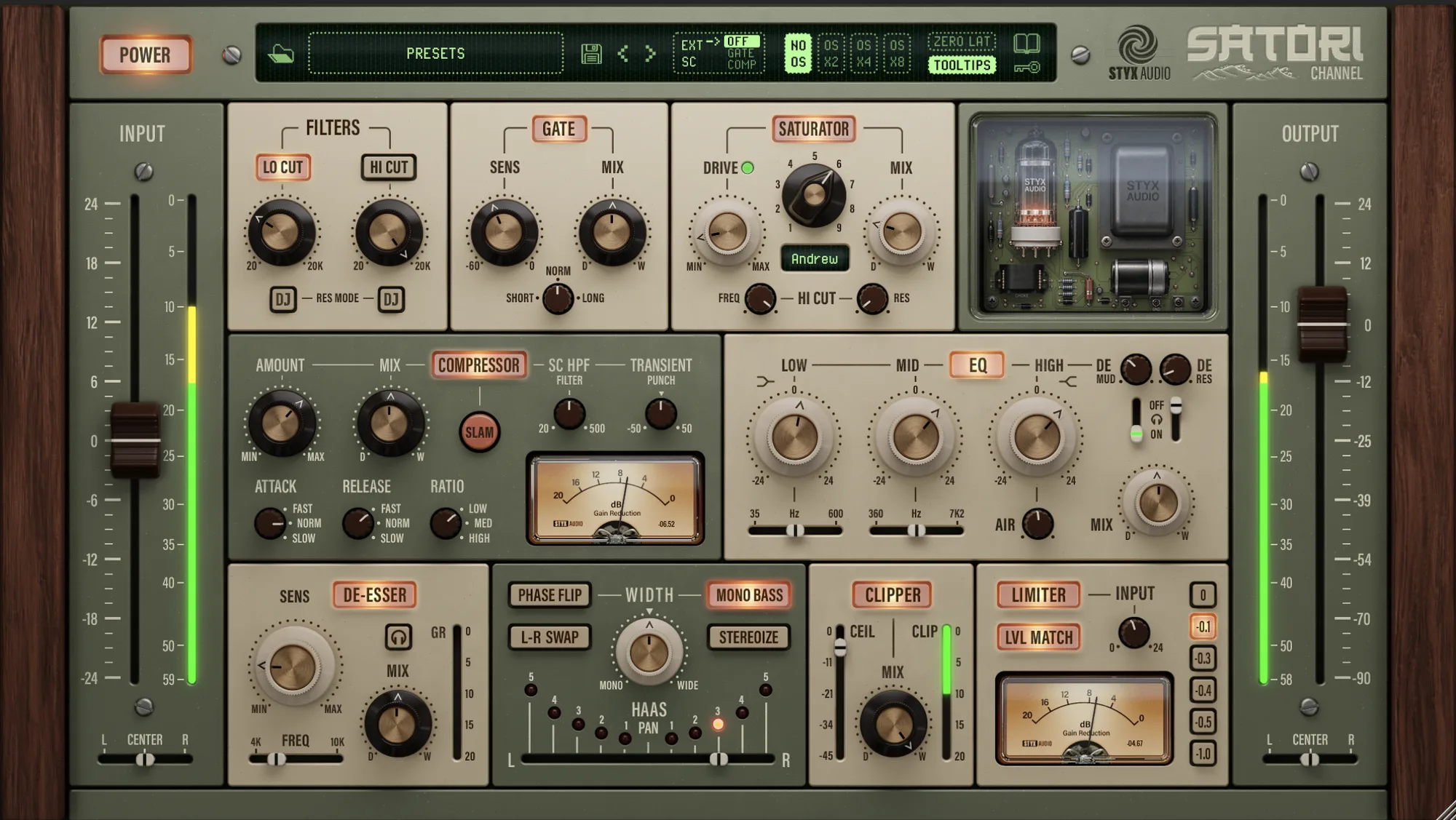 Watch it work
Hear the Difference
Compare the original signal with Satori Channel applied. Same source, same level, one plugin.
Press play, then switch between Original and Satori Channel.
Not Another Console Strip
Traditional channel strips stop at filters, gate, EQ, compression and a little analog color. You still stack a saturator, transient shaper, de-esser, stereo tool, clipper and limiter on top.
Satori Channel was built to be the only plugin most tracks need — to get a top sound fast.
Analog Thinking. Modern Workflow.
Many modern strips let AI decide what your sound needs. Satori Channel does not: every processor is built on the behavior of classic analog chains, and every module is tuned to sound musical from the first touch — the sweet spot is already under your fingertips.
Choose the character. Set the amount. Shape the result.
Nine Saturation Colors. One Click Away.
Nine distinct analog-inspired modes — from subtle warmth to aggressive destruction. Choose a circuit, dial in with Drive and Mix, shape with dedicated High Cut and resonance.
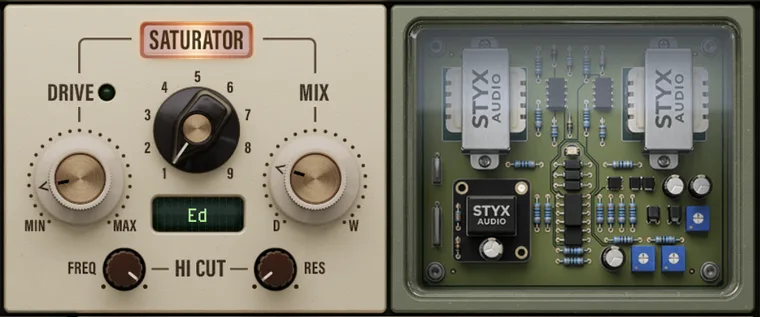
Ed
Clean, smooth preamp color with big transformers. The gentlest mode — safe on anything.
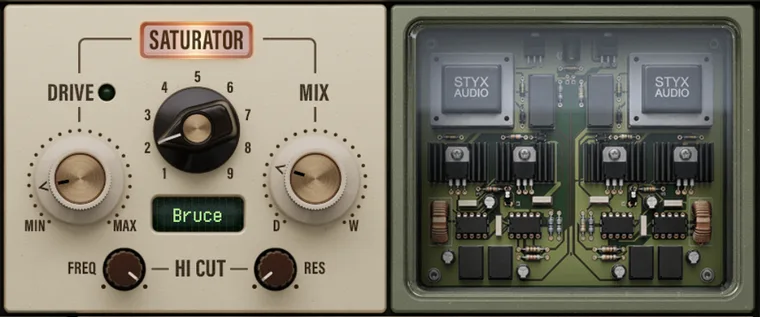
Bruce
Modern hybrid Class-A color. Tight, clean and punchy with no softening.
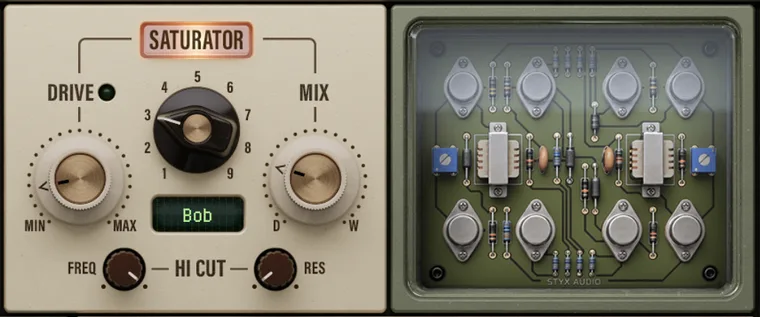
Bob
Vintage germanium transistor glow. Soft, rounded lows and a slightly hazy top.
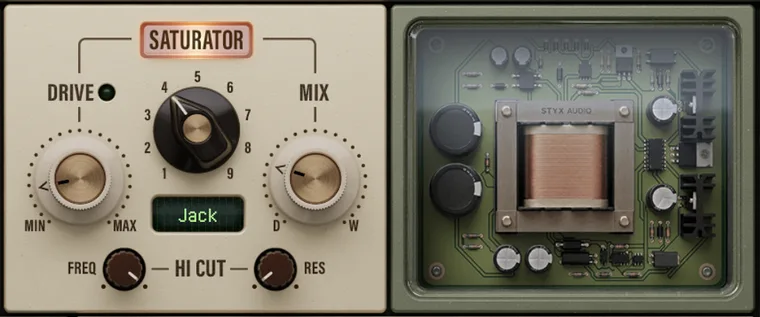
Jack
Big iron transformer drive. Adds weight and punch to the low end.
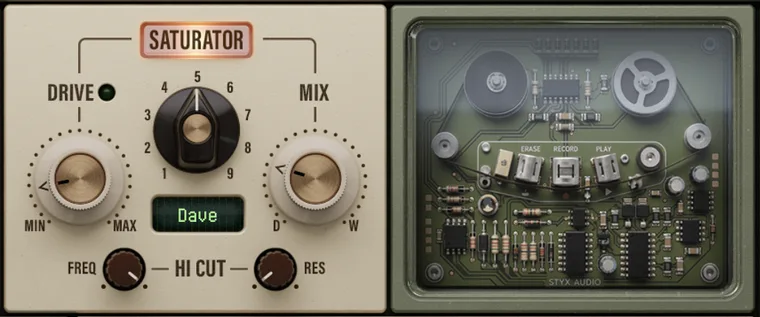
Dave
Reel-to-reel tape saturation. Glues the sound and softens harsh peaks.
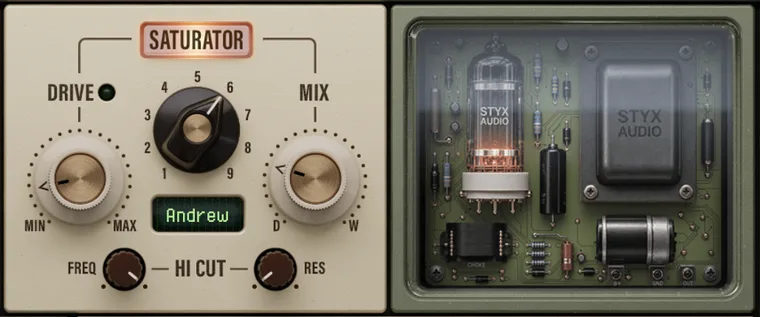
Andrew
Single-tube character with a woody, midrange-forward tone. Good for adding presence.
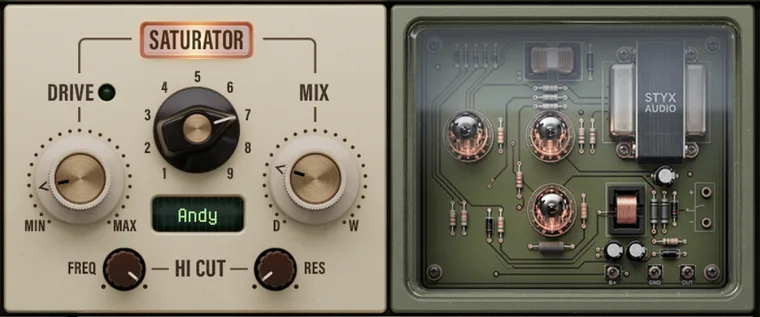
Andy
Rich three-tube warmth with a high-voltage supply. Thick and forgiving on vocals.
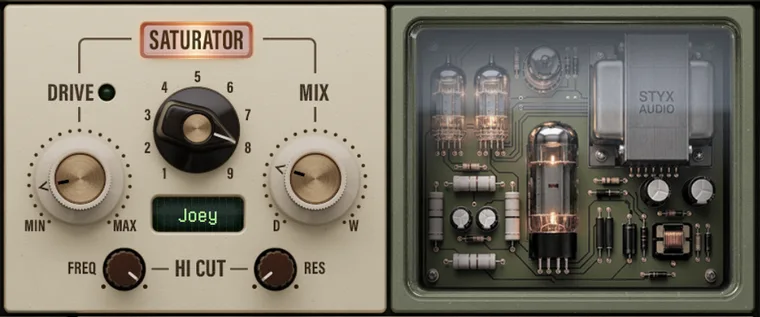
Joey
Power-tube drive pushed hard. The loudest, most aggressive tube flavor.
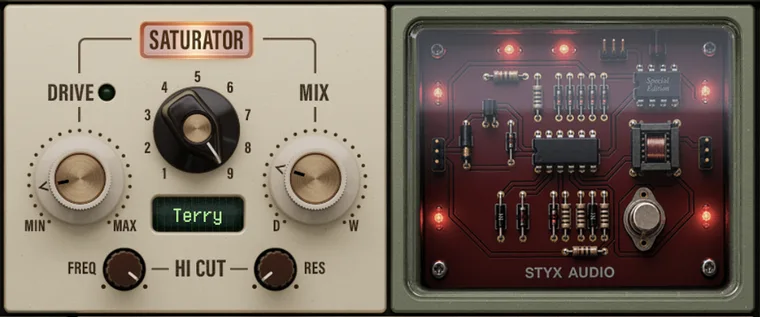
Terry
Solid-state overdrive with diode clipping. Gritty and edgy — great on drums and guitars.
Everything You Need to Shape and Finish a Sound
And almost everything works in parallel — each module has its own Mix control.
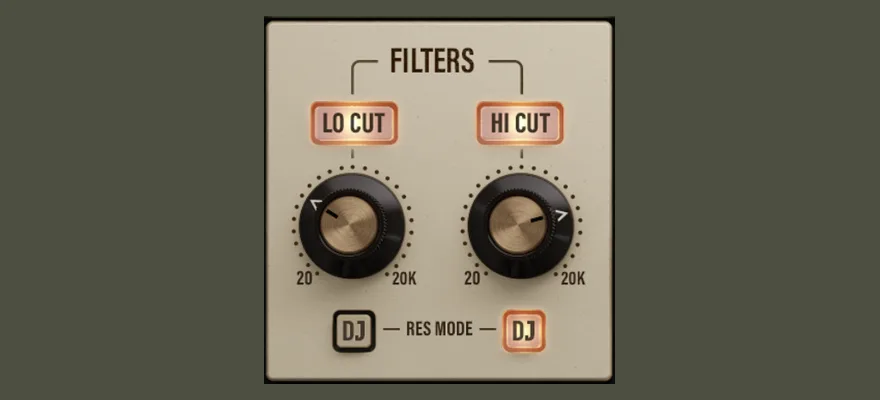
Filters
Flexible Low Cut and High Cut filters with two modeled behaviors — classic console and DJ-mixer style.
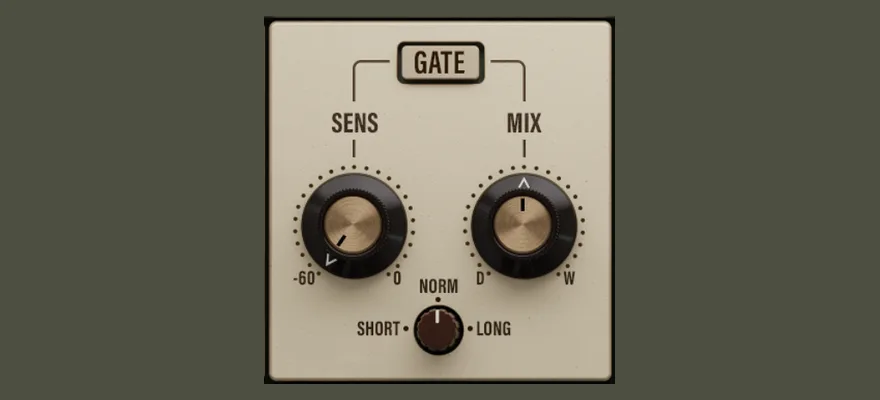
Gate
Control noise, bleed and unwanted tails: adjustable sensitivity, three release modes and parallel Mix.
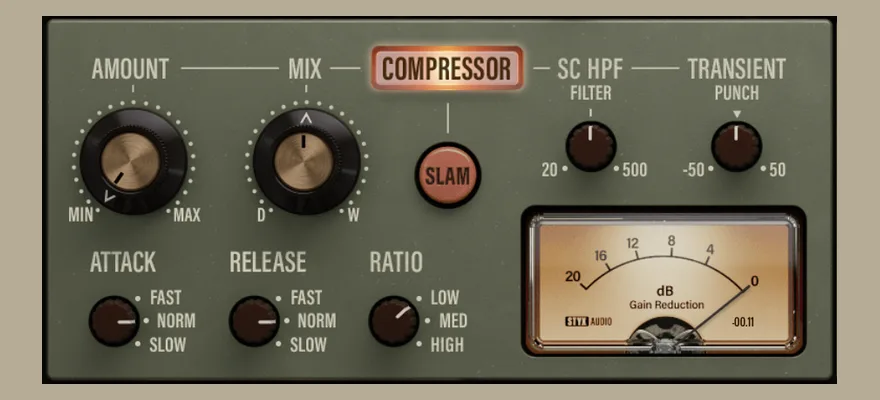
Compressor
Amount and Mix — two immediate controls. Inside: a double-stage design (slow + fast compressors), sidechain filter and Transient Punch. Slam adds a third, pumping stressor-type compressor.
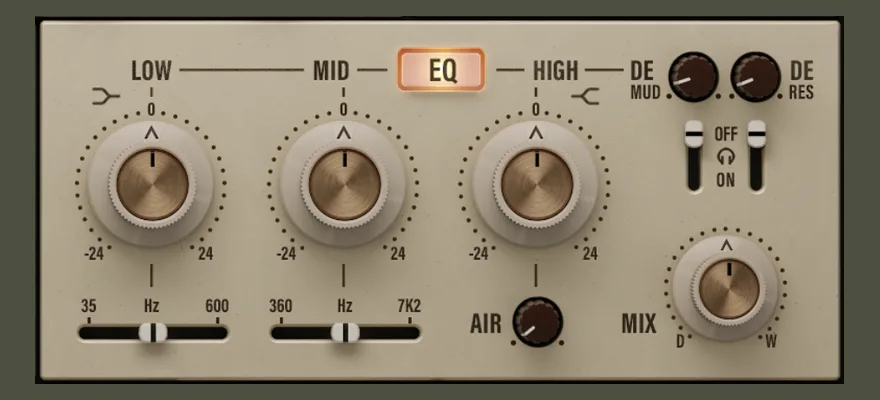
EQ & Air
Two classic analog EQs: a three-band section modeled after a vintage British console and an Air band from a famous mastering EQ — plus two notch filters for mud and resonances. Works in parallel.
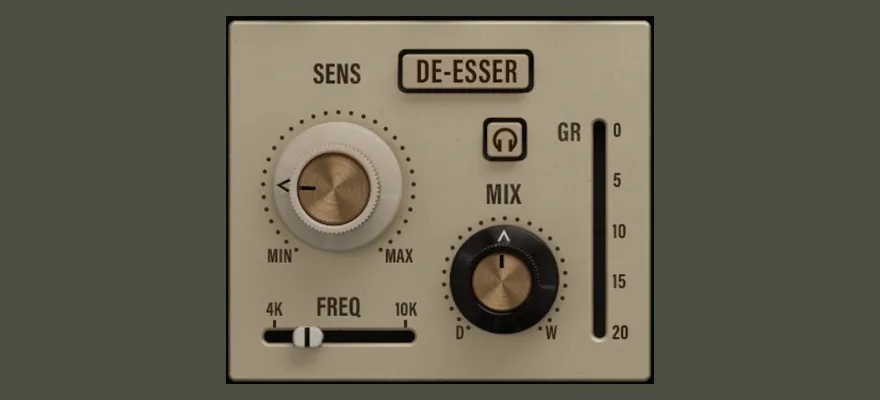
De-Esser
Direct control over frequency, sensitivity and parallel Mix. Listen mode isolates the problem area; the reduction meter shows exactly how much is applied.
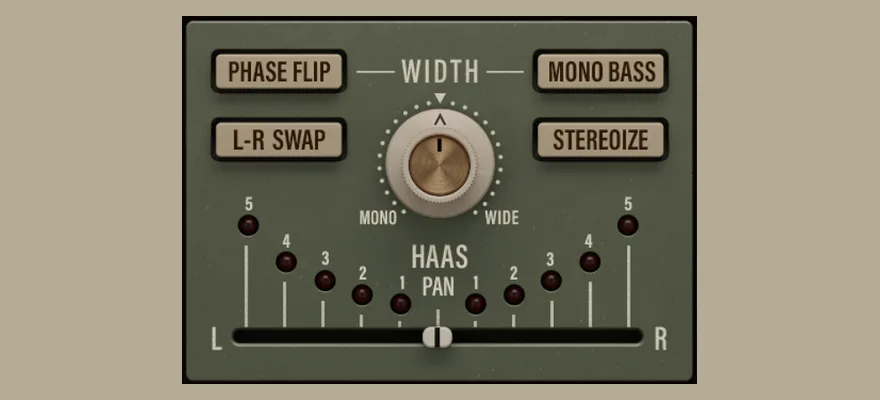
Width, Stereoize & Haas Panner
Stereoize turns mono into a spacious, moving stereo image using tape-drift timing and pitch variations — mono-compatible. Plus a stereo expander, LF mono maker, Phase Flip, L-R Swap and a Haas panner.
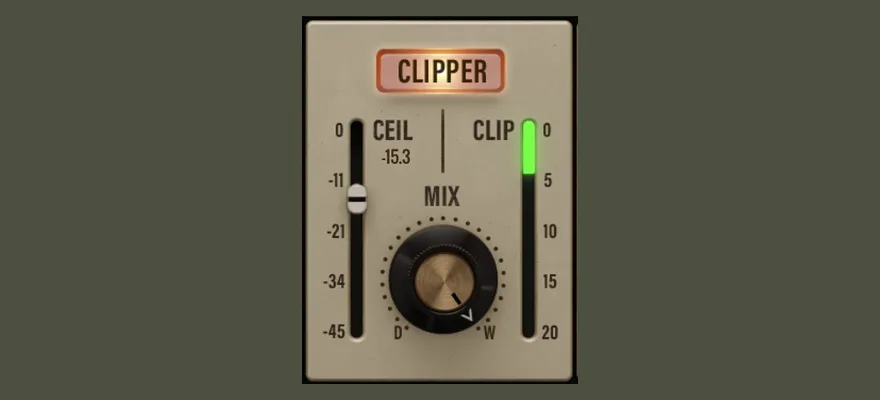
Clipper
Catch sharp transients: parallel Mix, adjustable Clip Ceiling and clear metering that shows exactly how the signal is being affected.
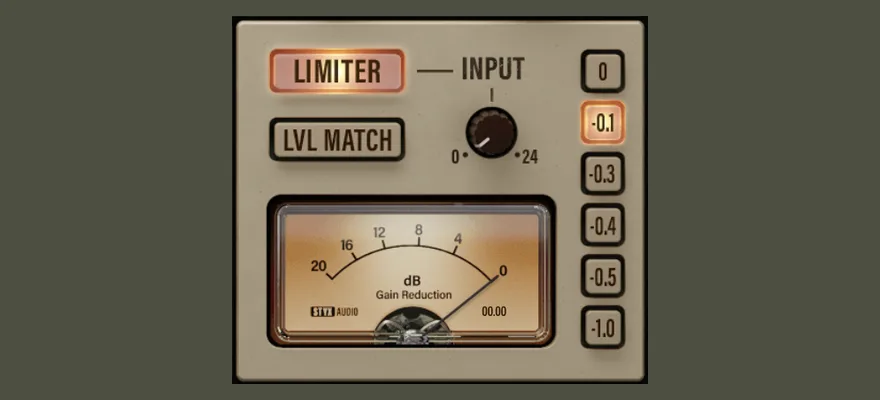
Limiter & Level Match
Finish the chain: selectable output ceilings, input drive, gain-reduction metering. Built-in Level Match compares processed and original at equal perceived loudness — judge the processing, not the volume.

500+ Hand-Crafted Presets
Not the usual filler bank — every preset is dialed in by hand for all the main instruments, acoustic and electronic. Pick one, and the whole chain is already in a musical place.
Parallel Processing Built Into the Workflow
Gate, saturation, compression, EQ, de-essing and clipping each have their own Mix control — parallel processing without extra buses or duplicate tracks. Individual module bypasses make honest comparisons instant.
A Complete Modern Channel
Not a random collection of processors — one cohesive system from source to finished sound.
- Console + DJ Desk Filters
- Gate
- Nine-mode saturation engine
- Saturation tone & resonance controls
- Double-stage compression
- Transient Punch
- Slam mode
- Analog-style three-band EQ
- Air band
- De-Mud notch filter
- De-Res notch filter
- De-Esser
- Phase Flip & L-R Swap
- LF mono maker (Mono Bass)
- Tape-drift Stereoize
- Stereo expander (Width)
- Psychoacoustic Haas panner
- Parallel clipper
- Final limiter
- Level Match
- Input & output gain and panning
- External sidechain support
- Zero-latency & oversampling modes
- 500+ hand-crafted presets
More Videos
Short demos and tips from the Styx Audio YouTube channel.
One Plugin Instead of an Entire Chain
Every module in Satori Channel exists as a piece of studio hardware. Bought separately for one stereo track, mid-range units add up to more than $25,000.
This compares similar functions only. The estimate is based on types of equipment, not on any specific product. We do not claim that Satori Channel is modeled on, sounds identical to, or is affiliated with any particular hardware.
Two EQs, two compressors, gate, de-esser, transient shaper, nine saturation units and a delay line for Haas panning, each one a separate box. Counted for one stereo track.
Everything in one carefully integrated plugin.
VST3 · AU · AAX · macOS 10.15+ (Intel & Apple silicon) · Windows 10+ · v1.0.2
Frequently Asked Questions
What is Satori Channel?
Satori Channel is an all-in-one channel strip that combines analog-inspired tone shaping with a complete modern processing chain. It includes filters, gating, nine saturation modes, compression, transient shaping, EQ, de-essing, stereo processing, a psychoacoustic Haas panner, clipping and limiting.
How is it different from a traditional channel strip?
Most channel strips focus on filters, gating, EQ, compression and basic console-style saturation. Satori Channel also includes the processors normally added before or after a conventional strip: transient control, de-essing, resonance reduction, stereo generation, psychoacoustic panning, clipping and final limiting.
Is Satori Channel AI-driven?
No. Satori Channel does not make mixing decisions for you. Its processing is based on the behavior and signal flow of classic analog chains. Every module is carefully tuned to provide musical results quickly, while keeping the final decisions in your hands.
Is it only for experienced engineers?
No. The main controls are designed to be immediate and easy to understand, while advanced options remain available when you need more precise control.
Satori Channel also ships with a built-in library of 500+ presets — not the usual filler bank, but starting points dialed in by hand for all the main instruments, acoustic and electronic alike. Pick one, and the whole chain is already in a musical place — then adjust to taste.
Can it replace my existing plugin chain?
Satori Channel is designed to cover the complete everyday processing chain — from cleanup and tone shaping to stereo control, clipping and final limiting. You can still use your favorite specialist tools, but many sounds can be taken from raw to finished entirely inside Satori Channel.
How much CPU does it use?
Satori Channel is built to sit on every channel of a mix. In our test, Logic Pro ran 60 instances at once (59 stereo tracks plus one on the master) without dropouts, each with the core chain on: filters, saturator, compressor, EQ and limiter, no oversampling. Enabling the remaining sections (gate, de-esser, clipper, stereoize) adds only a little on top.
Test machine: MacBook Pro 16-inch 2021, Apple M1 Max. Logic Pro settings: I/O buffer 512 samples, Processing Threads Automatic, Process Buffer Range Large, Multithreading Playback Tracks.
Your result will be higher or lower depending on your computer, buffer size and what else is in the project. Newer Macs will handle more: the base M5 is roughly 25% faster in multi-core benchmarks, the M5 Max about twice as fast. Older or base-model machines will handle fewer.
Oversampling is the one setting that changes the load a lot: 2X roughly doubles it, 4X triples it. Keep it off while tracking and switch it on where you can hear the difference.
The most honest number is the one you measure yourself. Download the 14-day trial, put Satori Channel on one track, then duplicate that track until playback starts to glitch. That is the real headroom on your machine.
What plugin formats and DAWs does Satori Channel support?
Satori Channel is available as VST3, AU (macOS) and AAX, 64-bit only, on macOS 10.15 or later (Intel and Apple silicon native) and Windows 10 or later. It runs in any DAW that hosts these formats, including Logic Pro, Pro Tools, Ableton Live, Cubase, FL Studio, Studio One and REAPER.
How much latency does Satori Channel add?
With default settings the plugin reports 16.5 ms of look-ahead latency (792 samples at 48 kHz, constant across sample rates), which your DAW compensates automatically. Oversampling adds about 3–4 ms on top. ZERO LAT mode disables look-ahead and brings latency down to 3 samples (≈0.06 ms) — use it for tracking and live performance. Measured values for every mode are in the Technical Specifications section below.
Does it support external sidechain?
Yes. The EXT → SC switch routes an external sidechain to either the Gate (open the gate from another track) or the Compressor (duck this track in response to another). Set up the sidechain send in your DAW as usual.
Is there a free trial, and on how many computers can I use it?
Yes — a free 14-day trial of the full version, no credit card required. A license includes 3 activations, and offline activation is supported for studio machines without internet access.
Technical Specifications
The complete module-by-module reference — every parameter, range and measured figure. Plugin version 1.0.2, specifications verified 6 November 2026.
Overview & formats
Satori Channel is an all-in-one channel strip plugin for mixing, designed by Roman Styx, a working mix and mastering engineer. It combines console and DJ-style filters, a gate, nine analog saturation circuits, a two-stage compressor with transient shaping, a British-console-style EQ with an AIR shelf and two notch filters (De-Mud, De-Res), a de-esser, stereo processing with a psychoacoustic Haas panner, a clipper, a limiter and loudness matching. No AI processing: every module is tuned so useful settings are easy to find, usually with a single main control.
| Formats | VST3, AU (macOS), AAX — 64-bit only |
| macOS | 10.15 or later, Intel & Apple silicon native; ≥8 GB RAM (16 GB recommended), 400 MB disk |
| Windows | Windows 10 or later; ≥8 GB RAM (16 GB recommended), 200 MB disk |
| Sample rates | Verified at 44.1, 48, 96 and 192 kHz |
| Sidechain | External sidechain routable to Gate or Compressor |
| License | $120 · 14-day free trial · 3 activations · offline activation supported |
| Released | 14 October 2026 · current version 1.0.2 |
Signal flow
The modules are arranged in a fixed chain: Input gain & pan → Lo Cut / Hi Cut filters → Gate → Saturator (with its own filter) → Stereoize → De-Esser → Compressor (with Slam and Transient Punch) → EQ (Low, Mid, High, Air, De-Mud, De-Res) → Stereo (Haas Pan, Phase Flip, Mono Bass, Width) → Output pan → Clipper → Limiter → LVL Match → Output level.
Internally the chain runs as 17 parallel DSP rows with over 60 processing nodes: two program compressors plus a third high-intensity stage for SLAM, a dedicated transient shaper, a tape-drift generator for Stereoize, an inter-channel delay line for Haas Pan and an M/S path for Mono Bass. Gate, saturator, compressor, EQ, de-esser and clipper each have a dedicated MIX control for parallel processing without extra buses, and each module has its own on/off button.
Filters & Gate
LO CUT and HI CUT are console-style high-pass and low-pass filters, each sweeping 20 Hz – 20 kHz with an independent on/off button. The DJ buttons switch each filter to a resonant mode with an emphasis peak at the cutoff — for filter sweeps, or for the classic analog low-end bump (LO CUT at 40 Hz in DJ mode).
The Gate attenuates the signal below its threshold — for noise, bleed and unwanted tails:
| SENS | Threshold, −60 to 0 dB |
| MIX | Gating depth: from none down to −60 dB attenuation when closed; intermediate settings keep some bleed for a natural result |
| Release | SHORT / NORM / LONG = 80 / 150 / 300 ms release time constant (measured close time to −40 dB attenuation: ≈115 / 185 / 335 ms) |
| Look-ahead | 2 ms, so the gate opens before the transient |
| Sidechain | EXT → SC set to GATE opens the gate from another track |
Saturator — nine circuits
DRIVE sets the amount of saturation (the LED shows activity), MIX blends it in parallel. The circuit selector switches between nine analog saturation characters:
| 1 · Ed | Solid-state preamp with large input and output transformers — the cleanest circuit |
| 2 · Bruce | Hybrid Class-A circuit: discrete transistors and op-amps, tight and punchy |
| 3 · Bob | Discrete germanium transistor preamp: rounded lows, slightly hazy highs |
| 4 · Jack | Large iron-core transformer: clean at low drive, dense harmonics when pushed |
| 5 · Dave | Reel-to-reel tape character: smooth warmth, softened peaks |
| 6 · Andrew | Single tube with choke and output transformer: prominent even-order harmonic, forward midrange |
| 7 · Andy | Three-tube stage with high-voltage supply: dense, full-bodied |
| 8 · Joey | Preamp tubes driving a power tube: the loudest, brightest tube circuit |
| 9 · Terry | Solid-state overdrive with diode clipping: the most aggressive |
FILTER processes only the saturated signal: one bipolar knob where the left half sweeps a low-pass across 20 Hz – 20 kHz, the right half a high-pass across 20 Hz – 20 kHz, and the center leaves it open. RES adds a resonant peak at the cutoff. The knob displays the actual cutoff frequency in Hz.
The default preset loads with gentle saturation engaged: THD ≈0.25 % at 0 dBFS (H2 −67 dBc, H3 −52 dBc), measured.
Compressor, Slam & Transient Punch
A two-stage design combining slow and fast compression, controlled by two main knobs; a third high-intensity stage (SLAM) can be blended on top. The main stage uses an RMS detector; the second, faster stage uses a peak detector with 3 ms look-ahead and program-adaptive (latched) release tracking.
| AMOUNT | Adjusts the thresholds of both internal compressors, with automatic make-up gain |
| MIX | Parallel blend; the default center position is parallel compression out of the box |
| ATTACK | FAST / NORM / SLOW — main RMS stage: 10 / 20 / 40 ms; fast peak stage: 1 / 4 / 10 ms |
| RELEASE | FAST / NORM / SLOW — main RMS stage: 150 / 353 / 500 ms; fast peak stage: 23.5 / 60 / 120 ms |
| RATIO | Main stage: LOW = 2:1, MED = 4:1, HIGH = 10:1 |
| SC HPF | Sidechain high-pass, 20–500 Hz — reduces pumping from kick and bass |
| TRANSIENT PUNCH | Bidirectional transient shaper (−50 to +50 %), independent of AMOUNT |
| SLAM | Additional high-intensity compressor for forceful parallel energy |
| Sidechain | EXT → SC set to COMP triggers gain reduction from another track |
Attack and release figures are the time constants set in the processing chain, read from the DSP rack. The two-stage design is program-dependent, so the effective response varies with the material.
EQ, Air, De-Mud & De-Res
The main EQ is modeled on a classic British console; AIR draws on the high shelf of a classic mastering EQ known for its top-end character. The entire EQ section runs in parallel, with MIX at 50 % by default — shape the tone, then scale the whole effect with one knob.
| LOW | ±24 dB, frequency 35–600 Hz |
| MID | ±24 dB, frequency 360 Hz – 7.2 kHz |
| HIGH | ±24 dB |
| AIR | High shelf, 0–30 dB — open, silky top end |
| DE MUD | Low-mid cut band (≈−6 dB bell), frequency 100 Hz – 5 kHz; OFF / find (🎧) / ON switch |
| DE RES | Narrow notch (≈−20 dB), frequency 100 Hz – 10 kHz; same three-position switch |
The 🎧 position boosts the selected area so you can locate buildup or a resonance by ear, then switch to ON to apply the cut.
De-Esser
| SENS | 0–100 % lowers the threshold from 0 to −50 dB |
| FREQ | Monitored range 1–10 kHz |
| MIX | Depth of de-essing, from none down to −18 dB maximum attenuation |
| 🎧 Listen | Solos the processed frequency range while you dial it in |
| GR meter | Shows the reduction applied to sibilance and harsh peaks |
Stereo: Width, Mono Bass, Stereoize & Haas Pan
| WIDTH | Mono ↔ wide; the center position preserves the original width (unity) |
| MONO BASS | Sums content below 120 Hz to mono by filtering the Side channel at 24 dB/oct — focused low end, consistent on big systems |
| STEREOIZE | Generates stereo width from the Mid channel using tape-like timing drift, adding Side content only in the midrange; mono-compatible, works on mono and stereo sources |
| HAAS PAN | Psychoacoustic panner using inter-channel delay: five steps per side — 3, 7, 12, 16, 20 ms; C = off. Positions a source without lowering either channel's level |
| PHASE FLIP / L-R SWAP | Polarity inversion and channel swap |
Clipper, Limiter & LVL Match
| Clipper CEIL | Clipping threshold, 0 to −45 dB |
| Clipper MIX | Parallel blend — below 100 % some original peaks remain |
| Limiter INPUT | −12 to +12 dB into the limiter |
| Limiter ceiling | Sample-peak: 0 / −0.1 / −0.3 / −0.4 / −0.5 / −1.0 dB. Inter-sample peaks can exceed the ceiling, especially without oversampling |
| LVL MATCH | Matches output loudness to input loudness for honest level-matched A/B comparison; calibrates on the passage playing when enabled |
Latency & CPU — measured
Measured on version 1.0.2 with an impulse test; the plugin reports its latency to the host, so your DAW compensates automatically. Verified at 44.1, 48, 96 and 192 kHz.
| Mode | Latency at 48 kHz |
|---|---|
| Default (look-ahead, NO OS) | 792 samples · 16.5 ms (constant time at all sample rates) |
| + OS X2 | adds 151 samples (≈3.1 ms) |
| + OS X4 | adds 189 samples (≈3.9 ms) |
| + OS X8 | adds 201 samples (≈4.2 ms) |
| ZERO LAT (NO OS) | 3 samples (≈0.06 ms) |
| ZERO LAT + OS X2 / X4 / X8 | 154 / 192 / 204 samples (≈3.2 / 4.0 / 4.3 ms) |
Oversampling applies to the Saturator and Limiter. CPU: in our test, Logic Pro on a MacBook Pro 16″ 2021 (M1 Max, I/O buffer 512) ran 60 simultaneous instances of the core chain (filters, saturator, compressor, EQ, limiter, no oversampling) without dropouts. OS X2 roughly doubles the per-instance load, OS X4 roughly triples it.
Presets — the full 500+ library by instrument
500+ factory presets, every one dialed in by hand and organized by instrument — from kick, snare and 808 through bass, guitars, keys, synths, strings, brass and woodwinds to lead vocals, backing vocals, rap and speech, plus dedicated Bus, Pre-Master, Quick Fixes, Sidechain and Creative folders.
The full factory library by folder — every preset is named after the source it was built for, so if your instrument is on this list, there is a hand-crafted starting point for it (numbered variants are collapsed):
Quick Start: Default Preset; Empty Preset; Germanium Magic; Light Compression & Brighter; Light Compression & More Attack; Light Compression & Warmer; Light Compression & Wider; More Punch & Energy.
Fixes: Brighter; Bring Forward; Console Grit; Darker; De-Boom; De-Ess; Even Out Dynamics; Fuller; Glue; Mono Bass; More Air; More Presence; More Punch; Remove Mud; Sit in the Back; Soft Clip; Stereoize; Tame Harshness; Tape Color; Translate on Phones; Tube Warmth; Warmer; Wider & Brighter.
Kick: 808 Kick (3 variants); 909 Kick (2 variants); Electronic Kick (4 variants); Kick (4 variants); Kick In (3 variants); Kick Out (3 variants); Kick Sample (3 variants); Kick Sub (2 variants).
Snare & Clap: Brushes; Cross-Stick; Electronic Clap (4 variants); Electronic Snare (4 variants); Hand Claps (2 variants); Rim; Rimshot (3 variants); Snap; Snare (4 variants); Snare Bottom (2 variants); Snare Sample (3 variants); Snare Top (3 variants).
Hats & Cymbals: China; Crash (2 variants); Electronic Hi-Hat (3 variants); Electronic Open Hat (2 variants); Electronic Ride; Hi-Hat (3 variants); Ride (2 variants); Ride Bell; Splash; Tops Loop (2 variants).
Toms: Electronic Tom; Floor Tom (2 variants); Rack Tom (2 variants); Toms (3 variants).
Percussion: Agogo; Bongos; Cabasa; Cajon; Castanets; Claves; Congas; Cowbell; Cuica; Darbuka; Djembe; Electronic Perc (3 variants); Foley Perc; Frame Drum; Guiro; Log Drum (2 variants); Maracas; Perc Loop (2 variants); Shaker (2 variants); Sleigh Bells; Tabla; Taiko; Tambourine (2 variants); Timbales; Triangle; Woodblock.
Overheads & Rooms: Overheads (5 variants); Room Far (2 variants); Room Mono (3 variants); Room Stereo (3 variants); Trash Mic.
808 & Sub: 808 (5 variants); Sub Bass (4 variants).
Bass: Acid Bass; Bass Amp (2 variants); Bass DI (3 variants); Bass Guitar (3 variants); Fretless Bass; Mid Bass (2 variants); Reese Bass; Slap Bass; Synth Bass (4 variants); Upright Bass (2 variants); Wobble Bass.
Guitars: 12-String Guitar; Acoustic Guitar (2 variants); Acoustic Guitar DI; Acoustic Guitar Fingerstyle (3 variants); Acoustic Guitar Strumming (3 variants); Banjo; Clean Guitar (3 variants); Crunch Guitar (2 variants); Distorted Guitar (5 variants); Guitar DI; Guitar Solo (4 variants); Jazz Guitar; Mandolin; Muted Guitar; Nylon Guitar; Pedal Steel; Slide Guitar; Ukulele.
Keys: Church Organ; Clavinet; Combo Organ; Electric Grand; FM Piano; Felt Piano; Grand Piano (4 variants); Hammond (3 variants); Harmonium; Harpsichord; Honky-Tonk Piano; Mellotron; Rhodes (2 variants); Upright Piano (2 variants); Wurlitzer (2 variants).
Synths: Arp (3 variants); Bells (2 variants); Chords (3 variants); Lead (4 variants); Pad (4 variants); Pluck (4 variants); Sequence (2 variants); Stab (3 variants); Synth Brass; Synth Choir; Synth Strings; Talkbox; Texture (2 variants); Vocal Chop (2 variants); Vocoder.
Samples & Loops: Break (2 variants); Drum Loop (3 variants); Melody Loop (3 variants); Sample (4 variants); Vinyl Sample (2 variants).
Strings: Cello (3 variants); Double Bass (2 variants); Pizzicato; Staccato Strings; String Quartet; Strings (4 variants); Tremolo Strings; Viola (3 variants); Violin (3 variants).
Brass: Brass Section (3 variants); Flugelhorn; French Horn (2 variants); Horn Section (3 variants); Muted Trumpet; Trombone; Trumpet (2 variants); Tuba.
Woodwinds: Alto Sax; Baritone Sax; Bassoon; Clarinet; English Horn; Flute (2 variants); Harmonica; Oboe; Ocarina; Piccolo; Recorder; Soprano Sax; Tenor Sax; Woodwinds (2 variants).
Mallets & Bells: Celesta; Glockenspiel; Marimba (2 variants); Music Box; Tubular Bells; Vibraphone (2 variants); Xylophone.
Orchestral: Choir (3 variants); Harp (2 variants); Orchestra (4 variants); Orchestra Hit; Orchestral Drums (2 variants); Timpani.
World: Accordion; Bagpipes; Bandoneon; Charango; Didgeridoo; Duduk; Erhu; Fiddle; Hammered Dulcimer; Handpan; Kalimba; Koto; Ney; Oud; Pan Flute; Saz; Shakuhachi; Shamisen; Shehnai; Sitar; Steel Drums; Tin Whistle.
Vocals: Female Vocal (5 variants); Male Vocal (5 variants); Scream Vocal (2 variants); Whistle.
Backing Vocals: Ad-libs (2 variants); Backing Vocals (4 variants); Doubles (2 variants); Gang Vocals; Harmonies (2 variants); Ooh & Aah; Whisper.
Rap: Beatbox; Rap Ad-libs (2 variants); Rap Doubles (2 variants); Rap Vocal (5 variants).
Speech: Dialogue (2 variants); Narration; Podcast (3 variants); Spoken Word (2 variants); Voice-Over (2 variants).
Transitions & FX: Ambience; Crowd; Downlifter; Foley; Impact (2 variants); Reverse Cymbal; Riser (2 variants); Sub Drop; Sweep (2 variants).
Sidechain: 808 Duck; Bass Duck; Guitar Duck; Music Duck; Pad Pump; Podcast Ducking; Reverb Duck; Synth Pump.
Bus Presets: All Vocals Bus; Back Vocals Bus; Drum Bus (2 variants); Drum Bus Electronic; Drum Bus Jazz; Drum Bus Rock; FX Returns; Guitar Bus; Main Bus; Synth Bus.
Pre-Master: Master Bus Comp (5 variants); Pre-Master (10 variants).
Creative: Blown Out; Broken Speaker; Cassette; Chopped Gate; Club Next Door; Crush; Distortion; Fuzz; Gramophone; Laptop Speaker; Lo-Fi; Megaphone; Old Mono; Overdrive; Phone Speaker (3 variants); Pump; Radio; Resonant Filter; Squash; Super Wide; Telephone; Underwater; Vinyl; Walkie-Talkie.
Plus a separate Artist Presets folder with settings from music industry professionals, which expands with updates.
How Satori Channel compares (as of 6 November 2026)
This comparison was compiled on 6 November 2026 from each manufacturer's official product page and is accurate as of that date. Features and prices of other products may have changed since.
| Satori Channel | SSL Native Channel Strip 2 | Scheps Omni Channel 2 | Neve 88RS Channel Strip (UAD) | |
|---|---|---|---|---|
| List price | $120 | $149 | $149 | $149 |
| Saturation circuits | 9 | — | 4 | Preamp (transformer) |
| De-esser | Yes | — | Yes | — |
| Transient shaper | Yes | — | — | — |
| Clipper | Yes | — | — | — |
| Dedicated final limiter with selectable sample-peak ceiling | Yes (0 to −1.0 dB) | — | Output limiter (threshold only) | Limit mode in the dynamics section |
| Psychoacoustic (Haas) panner | Yes | — | — | — |
| Loudness-matched A/B | Yes | — | — | — |
| Runs natively, no DSP hardware | Yes | Yes | Yes | Requires UA hardware |
“—” means the feature is not listed on that manufacturer's official product page as of 6 November 2026 (features additionally cross-checked against the plugins' own interfaces where available). All product names are trademarks of their respective owners, used for identification only; no affiliation or endorsement is implied, and we do not claim Satori Channel is modeled on or sounds identical to any of these products. List prices as of 6 November 2026; current and sale prices may differ.
What Top Industry Pros Say About Styx Audio
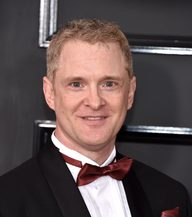
GRAMMY and TEC Award-winning engineer, mixing and Atmos mix specialist, with 16 GRAMMY Awards. Credits include Adele, Taylor Swift, Bruno Mars, The Weeknd, and Mark Ronson.
I’ve tried out Chakra on a couple of songs. It is very nice. I’ve used it on individual tracks where I tend to push it very hard, and on the master bus where it gives a nice width and bottom support.

GRAMMY-winning mixer, engineer and producer, founder of HINGE Studios in Chicago. Over 30 GRAMMY-nominated projects, including two Album of the Year nominations for Kanye West’s Late Registration and Graduation. Credits include Kanye West, The Clark Sisters, Donald Lawrence.
I’m as skeptical of one-knob plugins as you probably are… I put Chakra on this guitar thing that just sounded not great, turned it up and was wildly shocked. Don’t let one knob fool you, because it’s pretty damn cool.
Watch the original Reel on Instagram →
Grammy-winning producer and mix engineer (Adele, Taylor Swift, Dua Lipa, Ariana Grande, Celine Dion, OneRepublic, Twenty One Pilots, Quincy Jones)
It sounds cool! I like it on individual instruments.

Fabrice “Fab” Dupont is a Grammy-nominated, New York-based producer and mix/master engineer, owner of FLUX Studios (NYC) and co-founder of pureMix. Credits include Shakira, Jennifer Lopez, Bad Bunny, André 3000, Mark Ronson.
Chakra is my new subtle-but-powerful secret sauce for drum buss
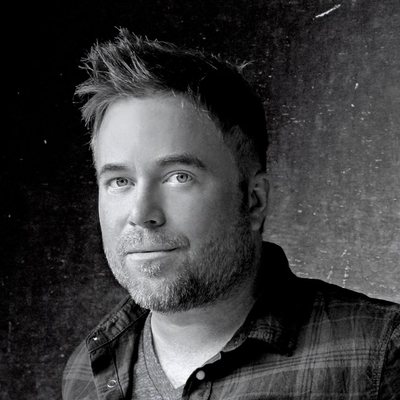
Grammy-nominated songwriter and producer (Keith Urban, Brad Paisley, Blake Shelton, Rascal Flatts)
Roman’s ears are pure gold! You can totally hear how much he cares about greatness when you turn the dials. The new Satori Channel is an absolute masterpiece and quickly became a go to. At this point I use everything Styx Audio has released on my sessions in Nashville every day.

Grammy- and Emmy-nominated mixing and mastering engineer (Robert Glasper, Megan Thee Stallion, Ne-Yo, King Crimson, High on Fire, Billy Ray Cyrus)
I’ve been playing with Chakra for a week and change now. To my ears it beefs up the sub, adds harmonic content in the high mids and highs but nothing harsh. It sounds best mixing through it as opposed to just slapping it on the master towards the end. Especially if the song needs to be opened up a bit, it’s perfect for giving it a nice sheen.
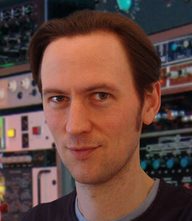
World-renowned mixing engineer, educator, and author of the bestseller Mixing Secrets for the Small Studio. Long-time Sound On Sound contributor and creator of the “Mix Rescue” series. Founder of Cambridge-MT.com.
It’s particularly good at making things sound subtly more ‘forward’, as well as pulling up sustain/detail components, and often seems to add a subtle sense of width/air too. I like the tonal options, but also that all the results are subtle enough to be musically useful.

Mastering engineer at Desert Park, Times Square, New York. Credits include Drake, Travis Scott, Snoop Dogg, Chris Brown, Pharrell, Nas.
Chakra isn’t adding too much friction, just making everything sound more interconnected — that’s why the master got approved.
Your Whole Chain Is Waiting
Nine saturation modes. Analog-inspired dynamics. Musical EQ. Tape-drift stereo generation. Psychoacoustic panning. Clipping. Limiting. One plugin built to replace the pile.
Also in a Bundle
Pay less than buying the plugins one by one. Own some already? Partial purchases charge you only for the ones you are missing.
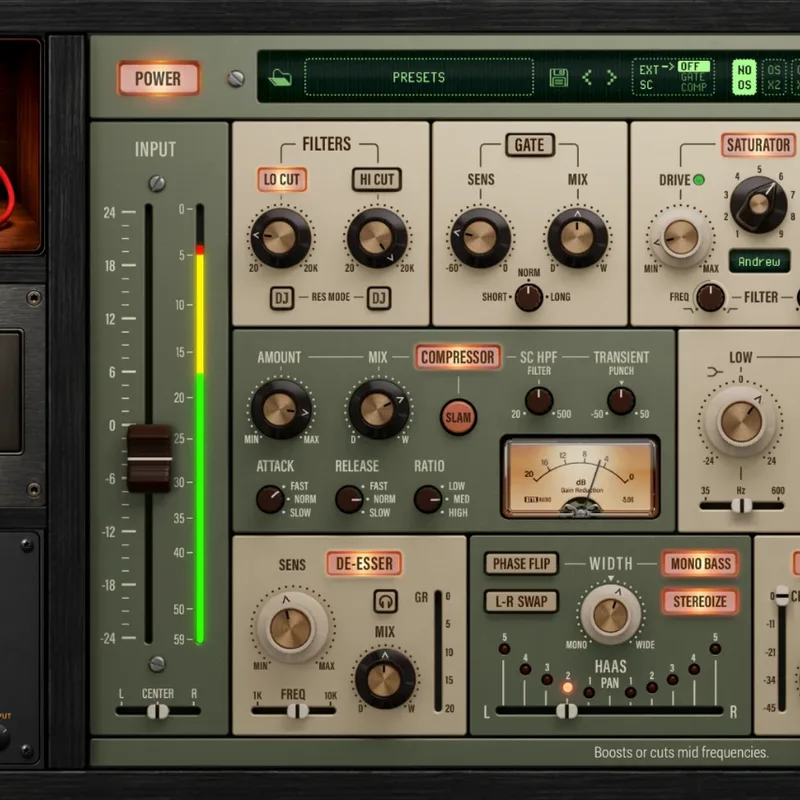
5-Plugin Bundle
Essential Mix Bundle
Tone shaping, harmonics and dynamics for tracks, buses and the master. All five, save 35% vs. regular prices.
Already own a Styx plugin? It comes off the bundle price.
You’re signed in. Plugins you already own from this bundle are not charged again.
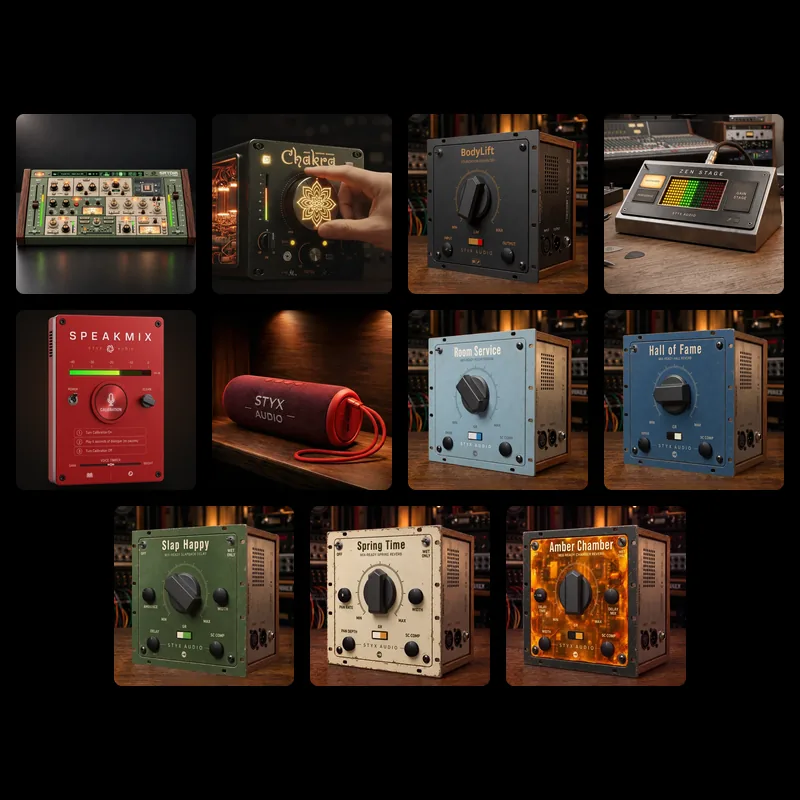
11-Plugin Bundle
Styx Audio Total Bundle
Every Styx Audio plugin in one purchase. All eleven, save 40% vs. regular prices.
Already own a Styx plugin? It comes off the bundle price.
You’re signed in. Plugins you already own from this bundle are not charged again.